General
Fire Suppression System Design & Product Development
The client develops advanced fire safety systems focused on early detection and rapid response. Their solutions are designed to protect lives and property across residential and industrial applications while meeting global standards for reliability and performance.
Scope
The project involved designing and developing three custom fire suppression system variants tailored to different application and installation requirements.
The scope included:
- Converting concept sketches into detailed, production-ready designs
- Integrating electronics, including PCB, sensors, and battery
- Designing cylinder systems along with tube routing, dip tubes, and fittings
- Finalizing spray nozzle selection and placement based on application
- Designing enclosures and housings for all components
- Developing mounting solutions for compact, wall, and ceiling installations
- Preparing manufacturing drawings for plastic and sheet metal parts

Challenge
- Space constraints: Fitting electronics, battery, and fluid components within limited space while maintaining access and clearances
- Spray coverage: Achieving consistent and effective discharge across compact, wall-mounted, and ceiling-mounted setups
- Electronics reliability: Protecting PCBs and sensors from heat, moisture, and vibration in a pressurized environment
- Mounting stability: Designing structures that handle load and vibration while remaining easy to install and remove
- Serviceability vs sealing: Ensuring easy access for refilling and maintenance without compromising sealing and safety
- Manufacturability: Converting early-stage concepts into production-ready designs without adding complexity
Solution
Leveraging our new product development services, the team developed a practical and manufacturable solution for the design and development of fire suppression systems for different applications. The focus was on creating reliable products that meet real-world performance, safety and manufacturing requirements.
Research & product design strategy for Fire Suppression Systems
The design process began with understanding different types of fire extinguisher and suppression systems, along with their real-world applications. Instead of jumping straight into design, the focus was on defining the right product approach for each use case—compact systems, wall-mounted units, and ceiling-mounted coverage.
This helped establish the right direction for capacity, spray behavior and overall product design from the start.
System-level product design & engineering integration
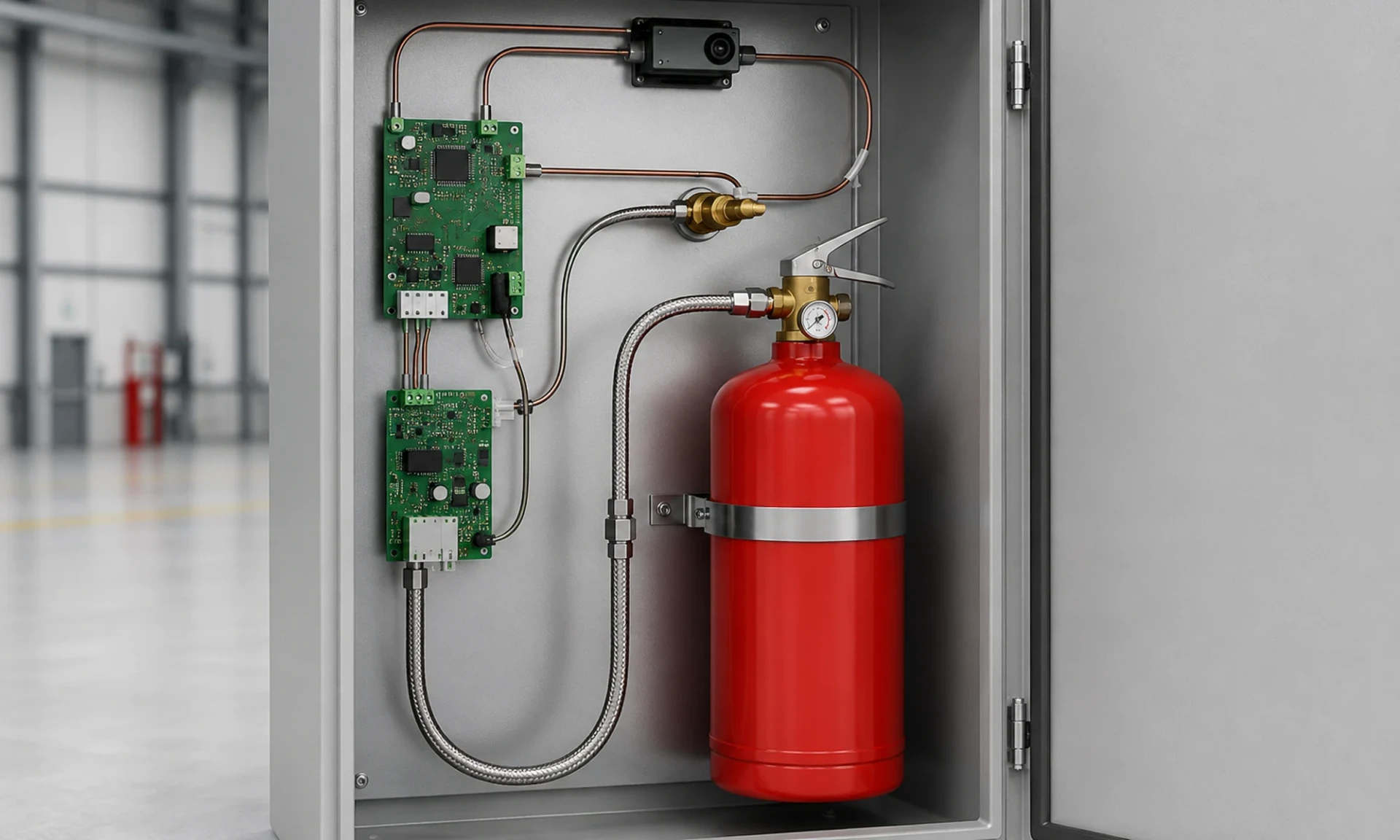
The product was engineered as a complete system rather than individual components. The cylinder, dip tube, manifold, tubing, spray nozzles, electronics, battery, and pressure components were all developed together.
This system-level approach ensured better integration between mechanical, electrical, and fluid systems — reducing design conflicts and improving overall reliability.
Application-based Fire Suppression System Design
Different applications required different fire protection approaches. To meet these requirements, our engineers designed three fire extinguisher system variants: a compact design for space-constrained installations, a wall-mounted design, and a ceiling-mounted design. Each variant featured a unique cylinder configuration, spray arrangement, mounting method, and electronics package optimized for its installation environment.
Instead of adapting a single design across all applications, we optimized each fire extinguisher design for its intended installation. This approach improved coverage, simplified maintenance and reduced installation space constraints.
Spray system design & fluid flow optimization
Spray performance was engineered based on actual usage conditions. Nozzle size, number, and placement were optimized to deliver effective coverage.
The use of 120° spray angles, along with properly designed dip tubes and manifolds, ensured uniform discharge while keeping the system efficient and compact.
Safety, standards & material selection
Safety and reliability were taken into consideration from the beginning. Pressure-rated components, secure sealing methods, and stable mounting systems were incorporated across all products.
We ensured the final design aligned with widely accepted standards, including NFPA guidelines for fire protection, ISO and EN standards for fire extinguishers, and IEC 60529 for IP-rated enclosures.
Material selection was based on functional requirements. Cylinders and fittings were chosen for pressure resistance and durability, while enclosure design balanced strength and weight.
We also designed sensor enclosures to meet IP68 requirements, ensuring reliable operation in demanding environments.
Design for Manufacturing (DFM) & production readiness
Manufacturability was considered early in the product design process. We used standard components wherever possible simplified geometries for fabrication.
Our design team ensured sheet metal and plastic parts were designed for real production methods. We developed detailed manufacturing drawings, including laser cutting files, to support smooth vendor execution and faster production readiness.
Value Engineering in product development
Our focus was not just on making the product work, but on making it practical. Installation was simplified through well-designed mounting systems, and serviceability was improved with easy access to battery and refill points.
This resulted in products that are easier to manufacture, install, and maintain while reducing complexity throughout the product lifecycle.
Value and Benefits
Reduced development time through a structured approach from concept to manufacturing-ready design
Minimized redesign and production risks through early focus on system integration and manufacturability
Improved fire suppression performance through optimized spray coverage and fluid system design
Simplified installation and maintenance through application-specific mounting and service-friendly designs
Accelerated production readiness with complete manufacturing documentation and standardized components
Related Case Studies


Advanced Tillage Unit Design – Agricultural Machinery
Designed a durable, versatile tillage unit - an advanced agricultural machinery meeting Australian, U.S., and European standards for various soils and tractors.


All-Terrain Vehicle (ATV) Plastic Component Design
Sedin product design team developed durable, lightweight ATV fender and audio mount components for off-road performance and cost-effective manufacturing.


Utility-Scale BESS Design for Data Centers
Sedin designed a utility-scale BESS for data centers, which boosted reliability, reduced energy costs and ensured uninterrupted power supply.